


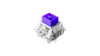




Si vous suivez un tant soit peu les jeux FPS compétitifs, vous avez forcément entendu parler de l'expression « Rapid Trigger » . Elle est devenue le terme générique désignant une génération de claviers à effet Hall conçus autour d'une promesse simple : dès que vous levez le doigt, même légèrement, d'une touche, l'entrée est enregistrée comme relâchée, et non lorsque vous franchissez un seuil physique arbitraire.
Pour la plupart des acheteurs de claviers, cela peut paraître un détail technique mineur. Pour les joueurs confirmés de Valorant, CS2 ou Apex Legends, en revanche, cela change fondamentalement la façon de contrer les déplacements latéraux. Cet article explique précisément le fonctionnement de Rapid Trigger, l'importance d'une précision de 0, 01 mm et les critères à prendre en compte pour choisir un clavier compatible avec votre configuration.
Le déclencheur rapide résout le problème
Sur tout clavier traditionnel, la frappe des touches repose sur un système à deux seuils : le point d'activation (la course de la touche avant son enregistrement) et le point de réinitialisation (la course de la touche avant sa désactivation) . Sur un interrupteur mécanique standard, le point d'activation est généralement de 2, 0 mm et le point de réinitialisation de 1, 8 mm.
Le problème pour les joueurs de FPS réside dans l'écart entre ces deux seuils. Lors d'une manœuvre de contre-strafe dans CS2 (appuyer sur A pour se déplacer à gauche, puis sur D pour s'arrêter et réinitialiser la précision) , le clavier doit enregistrer complètement le relâchement de A avant que D ne devienne la direction de déplacement active. Avec des seuils fixes, ce relâchement dépend du fait de lever physiquement le doigt au-delà de 1, 8 mm, ce qui introduit un délai perceptible.
Ces quelques millisecondes supplémentaires — et l'imprécision liée au mouvement des doigts qui ne se lèvent pas toujours exactement au même endroit — introduisent un délai dans la réactivité des commandes. En mode occasionnel, ce délai est imperceptible. En compétition, il fait toute la différence entre un tir précis et un personnage qui continue de glisser lorsqu'on tente de maintenir un angle.
Comment fonctionne réellement le déclencheur rapide
La fonction Rapid Trigger n'est possible que sur les claviers à effet Hall (magnétiques) car ces claviers n'utilisent pas de seuils de position fixes. Un capteur à effet Hall mesure en continu le champ magnétique d'un aimant intégré à la tige de la touche, suivant ainsi la position exacte de celle-ci en temps réel — avec une fréquence de transmission de 8 000 fois par seconde au micrologiciel sur les modèles haut de gamme.
Lorsque le déclenchement rapide est activé, le micrologiciel ne surveille pas un seuil fixe. Au lieu de cela, il surveille changement de directionDès que la touche commence à se déplacer vers le haut — même de 0, 01 mm — , le micrologiciel enregistre un relâchement. Dès qu'elle redescend selon la sensibilité configurée, il enregistre une pression. La touche réagit toujours à la position de votre doigt. actuellement Elle fait ce qu'elle faisait, et non ce qu'elle faisait il y a 1, 8 mm.
La sensibilité est entièrement configurable. Sur le MelGeek MADE68 Ultra V2 [1] La précision du déclencheur rapide est réglable de 0, 01 mm à 2, 5 mm via le logiciel Hive 2. 0 [2] . La plupart des joueurs compétitifs la règlent entre 0, 1 mm et 0, 3 mm : suffisamment sensible pour éliminer le délai de déclenchement, mais pas trop sensible pour éviter les reprises involontaires dues aux vibrations des doigts.

Que signifie réellement un taux d'interrogation de 8 000 Hz ?
La fréquence d'interrogation correspond à la fréquence à laquelle votre clavier communique son état à votre ordinateur. Un clavier standard à 1 000 Hz communique son état toutes les millisecondes. Un clavier à 8 000 Hz communique son état toutes les 0, 125 ms.
Pour que le déclenchement rapide fonctionne avec une précision maximale, il faut une fréquence d'interrogation suffisamment élevée pour détecter en temps réel des mouvements inférieurs au millimètre. À 8 000 Hz, MelGeek MADE68 Ultra V2 [1] Il est possible de détecter une inversion de touche en un seul cycle d'interrogation (0, 125 ms) . C'est pourquoi les technologies Rapid Trigger et d'interrogation à 8 000 Hz sont commercialisées conjointement. L'une sans l'autre limite les performances. L'article de TechPowerUp sur le lancement du Horus de MelGeek montre que la marque utilise l'interrogation à 8 000 Hz comme spécification de performance plus générale pour les périphériques de jeu [8] , tandis que le comparatif du MADE68 Ultra+ de MelGeek conserve le même cadre de performance à 8 000 Hz/effet Hall pour sa série MADE [7] –une norme que le MADE68 Ultra V2 maintient pour le clavier.
Déclenchement rapide en pratique : le contre-strafe dans CS2 et Valorant
Le contre-strafe consiste à appuyer sur la touche directionnelle opposée pour stopper l'élan de votre personnage avant de tirer. Dans CS2, pour un contre-strafe réussi, la touche A doit être complètement relâchée avant que la touche D ne soit activée.
Avec le déclenchement rapide à une sensibilité de 0, 1 mm, dès que vous commencez à lever le doigt (un mouvement ascendant de seulement 0, 1 mm) , la touche se relâche. Votre action D devient immédiatement la direction principale. Il n'y a pas de zone fixe à franchir. Vos contre-strafes deviennent aussi rapides et précis que les mouvements de votre doigt.
MelGeek s'associe officiellement à Cortezia [3] , joueur professionnel de VALORANT, qui utilise le Centauri 80 [4] pour le jeu compétitif d'élite — un clavier construit sur la même architecture de commutateur magnétique de troisième génération, avec Rapid Trigger à une précision de 0, 01 mm, un sondage de 8 000 Hz et le Flip King of Magnetic White Switch [5] [6] [9] [10] .
Snap Tap et SOCD : Fonctionnalités connexes à connaître
Le déclenchement rapide est parfois confondu avec deux fonctionnalités connexes : Snap Tap et Correction SOCDIls résolvent des problèmes connexes mais distincts.
Snap Tap La fonction SOCD (Simultaneous Opposite Cardinal Direction) privilégie la touche pressée en dernier lorsque deux touches directionnelles opposées sont maintenues enfoncées simultanément. Maintenez A et appuyez sur D : le clavier envoie la touche D. Relâchez D tout en maintenant A : la touche revient à A. Ceci permet un changement de direction fluide sans avoir à relâcher complètement la touche précédente.
Déclenchement rapide Il fonctionne au niveau de chaque touche, contrôlant le moment où chaque touche enregistre une pression ou un relâchement en fonction du sens de déplacement. Les deux fonctions peuvent fonctionner simultanément : le déclenchement rapide pour la sensibilité individuelle des touches et la pression instantanée pour le comportement simultané des touches opposées. MelGeek MADE68 Ultra V2 [1] prend en charge les deux simultanément via Hive 2. 0.
Saisie dynamique de touches (DKS) : quatre actions, une touche
La fonction Dynamic Keystroke associe jusqu'à quatre actions différentes à une seule touche, selon la profondeur de sa course, au cours d'une frappe continue. Une légère pression peut activer une fonction, une pression à mi-course une autre, et une pression maximale une troisième, le tout avec le même mouvement de la touche. Cette fonction est spécialement conçue pour les jeux FPS et MOBA, où les commandes à plusieurs étapes doivent s'exécuter en quelques millisecondes, une fonctionnalité sans équivalent dans les claviers mécaniques classiques.
MADE68 Ultra V2 vs. Centauri 80 : lequel est fait pour vous ?
|
Spécification
|
MADE68 Ultra V2
|
Centauri 80
|
|
Disposition
|
65 % (68 touches)
|
80 % (83 touches)
|
|
Prix
|
219 $
|
359 $
|
|
Taux de sondage
|
8 000 Hz
|
8 000 Hz
|
|
Déclenchement rapide
|
0, 01 mm
|
0, 01 mm
|
|
Changer
|
KOM Lite / Flip King Magnétique
|
Flip King Magnétique Blanc
|
|
Écran OLED
|
Non
|
Écran tactile de 1, 78 pouce (368 x 448, 325 ppp)
|
|
Sans fil
|
Filaire (USB-C)
|
Filaire (USB-C)
|
|
Cas
|
Alliage d'aluminium complet
|
Alliage d'aluminium
|
|
Éclairage
|
Panneaux latéraux à 360° + rétroéclairage
|
RGB orienté vers le sud + rétroéclairage
|
|
garantie
|
contrat limité de 2 ans
|
1 an limitée
|
Le MADE68 Ultra V2 [1] est le choix idéal pour les joueurs qui recherchent des performances maximales et une personnalisation modulaire à faire soi-même pour 219 $. Centauri 80 [4] (359 $) ajoute l'interface de contrôle OLED et une disposition plus large pour les joueurs qui souhaitent une surveillance en temps réel et des touches supplémentaires sans compromettre les performances de base de l'effet Hall.

Guide pratique d'installation du déclencheur rapide
- Point d'activation : débuter à 1, 2–1, 5 mm (plus léger que par défaut, évite les pressions accidentelles sans être trop sensible)
- Sensibilité du déclenchement rapide : 0, 1–0, 2 mm (réactif sans déclenchements fantômes dus aux micro-vibrations du doigt)
- Mode SOCD : priorité de la dernière touche (le plus souvent utilisé dans Valorant et CS2)
- Fréquence d'interrogation : 8 000 Hz (par défaut ; aucune modification nécessaire) MADE68 Ultra V2 ou Centauri 80)
- Exécutez l'étalonnage intégré dans Hive 2. 0 après la première configuration et après les mises à jour du firmware.
Après avoir configuré Rapid Trigger, consacrez 30 minutes à l'entraînement sur une carte personnalisée (Aimlabs ou atelier CS2) . La différence avec le système mécanique standard est immédiatement perceptible au niveau de la régularité des contre-strafe ; le temps d'adaptation est plus court que prévu.
Conclusion
La technologie Rapid Trigger est un véritable avantage matériel pour les jeux FPS, et non un argument marketing. Avec une sensibilité de 0, 01 mm et une fréquence de rafraîchissement de 8 000 Hz, la fenêtre de détection des entrées est bien inférieure au seuil de perception humaine. Si vous jouez à Valorant, CS2 ou Apex Legends de manière un tant soit peu sérieuse, un clavier équipé de la technologie Rapid Trigger vous offrira une réactivité bien supérieure à celle de n'importe quel interrupteur mécanique traditionnel. MelGeek MADE68 Ultra V2 et Centauri 80 sont tous deux conçus spécifiquement pour ce cas d'utilisation.
Références
[1] MelGeek — Clavier de jeu MADE68 Ultra V2 (Page produit officielle) . https://www.melgeek.com/products/made68-ultra-v2-gaming-keyboard
[2] Blog MelGeek — MADE68 Ultra V2 associe HIVE 2. 0 au contrôle FPS (avril 2026) . https://www.melgeek.com/blogs/melgeek-lab/made68-ultra-v2-ai-gaming-keyboard
[3] Blog MelGeek — MelGeek accueille Cortezia comme partenaire joueur professionnel (mars 2026) . https://www.melgeek.com/blogs/melgeek-lab/melgeek-welcomes-cortezia-as-its-pro-player-partner
[4] MelGeek — Clavier de jeu à effet Hall Centauri 60/80 (Page produit officielle) . https://www.melgeek.com/products/melgeek-centauri60-80-hall-effect-gaming-keyboard
[5] Games. gg — Test du clavier de jeu à effet Hall MelGeek Centauri 60/80 (mai 2026) . https://games.gg/news/melgeek-centauri-60-80-hall-effect-gaming-keyboard-review-2026/
[6] AP News / GetNews — MelGeek présente Centauri60 et Centauri80 (décembre 2025) . https://apnews.com/press-release/getnews/melgeek-presents-centauri60-and-centauri80-the-first-flagship-hall-effect-keyboards-with-integrated-hd-oled-display-d528c8516c68bb96040bbd42e0fe5034
[7] Blog MelGeek — Comparaison MADE68 Ultra+ vs MADE68 Ultra V2 (mai 2026) . https://www.melgeek.com/blogs/melgeek-lab/made68-ultra-plus-vs-ultra-v2
[8] TechPowerUp — MelGeek lance Horus avec le capteur PAW3950 et un véritable sondage sans fil de 8000 Hz (février 2026) . https://www.techpowerup.com/345995/melgeek-debuts-horus-with-paw3950-sensor-and-true-8000hz-wireless-polling
[9] Gadgets Geek — Test de la série MelGeek Centauri (novembre 2025) . https://www.geeky-gadgets.com/melgeek-centauri-series-review/
[10] Tutoriels de base — MelGeek lance Centauri60 et Centauri80 (décembre 2025) . https://basic-tutorials.com/news/melgeek-launches-centauri60-and-centauri80-introducing-a-new-performance-benchmark-for-hall-effect-gaming-keyboards/