







You've probably seen the terms "magnetic keyboard" or "Hall Effect keyboard" popping up everywhere lately. Two years ago, barely anyone outside enthusiast forums discussed them. Today, they're a centerpiece feature in product launches from gaming-focused brands worldwide. So what exactly changed — and does it actually matter for how you type or play?
This guide breaks down the real, engineering-level difference between traditional mechanical keyboards and the newer magnetic (Hall Effect) keyboards — and explains why the distinction matters whether you're a competitive FPS player, a remote worker, or just curious about why your next keyboard might not contain any metal contacts inside it at all.
How a Traditional Mechanical Keyboard Works
A mechanical keyboard switch is built around a physical contact mechanism. When you press a key, a plastic stem travels downward until two metal leaves inside the switch touch each other, completing an electrical circuit. That signal tells your computer: key pressed.
The tactile bump on a tactile switch (like Cherry MX Browns) comes from a small nub on the stem scraping over a leaf spring. The click sound on clicky switches (like MX Blues) comes from a separate click jacket. Linear switches (like MX Reds) have no bump at all — smooth travel from top to bottom.
This physical contact design has served keyboards reliably for decades. Most switches are rated for 50 to 100 million keystrokes. The inherent limitation: the actuation point is fixed at a specific travel depth, typically around 2.0 mm. You cannot change it without swapping the physical switch.
What Is a Magnetic (Hall Effect) Keyboard?
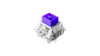
A Hall Effect keyboard takes a completely different approach. Instead of metal contacts, these switches contain a small magnet in the stem and a Hall Effect sensor on the PCB. As you press the key, the magnet moves closer to the sensor, which detects the change in magnetic field strength and converts it into a precise position reading — the keyboard always knows exactly how far down each key is, continuously measured in fractions of a millimeter.
Because there are no contacts to wear out, Hall Effect switches have theoretical lifespans exceeding 100 million keystrokes with no accuracy degradation. There is no bounce — the erratic re-triggering that mechanical contacts can suffer — and no need for debounce delay in firmware, which contributes to lower input latency.
"Magnetic keyboards" and "Hall Effect keyboards" are the same thing. "Magnetic" is the consumer-friendly name; "Hall Effect" is the engineering description.
The Three Capabilities That Change Everything
1. Adjustable Actuation Point
With a mechanical switch, you get one actuation point and that is it. With a Hall Effect keyboard, you can move that trigger point anywhere across the switch's travel range. On MelGeek's MADE68 Ultra V2[1], the actuation point is adjustable from 0.1 mm to 3.4 mm. Set it at 0.5 mm for hair-trigger response in Valorant, then shift it to 2.5 mm for a more deliberate typing feel when writing long-form content.

2. Rapid Trigger
This is the feature that sparked the Hall Effect keyboard's rise in competitive gaming. On a standard mechanical keyboard, the key resets at a fixed reset point — usually 1.8 mm, just above the 2.0 mm actuation. Even if you lift your finger just 0.1 mm, the key stays registered as pressed until you physically clear that threshold.
Rapid Trigger changes this fundamentally. Because the keyboard tracks position continuously, it can reset the key the moment your finger begins moving upward — by as little as 0.01 mm. For FPS players, this produces measurably cleaner counter-strafing in games like CS2 and Valorant.[2] MelGeek's MADE68 Ultra V2 achieves 0.01 mm Rapid Trigger precision.
3. No Contact Degradation
Mechanical contacts wear over millions of keystrokes — metal leaves can develop oxidation or micro-pitting, causing inconsistent actuation or chattering. Hall Effect switches have no contacts. The magnetic sensing remains accurate indefinitely, which is why gaming keyboard manufacturers are increasingly adopting this technology for professional and semi-professional play.
Mechanical vs. Magnetic: Side-by-Side Comparison
|
Feature
|
Traditional Mechanical
|
Magnetic / Hall Effect
|
|
Actuation detection
|
Physical metal contact closure
|
Contactless Hall Effect sensor
|
|
Actuation point
|
Fixed (e.g., 2.0 mm)
|
Fully adjustable (0.1–3.4 mm on MADE68 Ultra V2)
|
|
Reset point
|
Fixed (slightly above actuation)
|
Adjustable to 0.01 mm via Rapid Trigger
|
|
Switch lifespan
|
50–100M keystrokes rated
|
100M+ (no contact wear)
|
|
Debounce delay
|
Required (~5–10 ms firmware)
|
Minimal or eliminated
|
|
Switch feel variety
|
Linear, tactile, clicky
|
Primarily linear
|
|
Firmware customization
|
VIA/QMK remap
|
Deep: RT, DKS, SOCD, dynamic actuation
|
|
Wireless availability
|
Widely available
|
Limited; primarily wired gaming models
|
|
Price range
|
Budget to flagship ($30–$300+)
|
Mid to flagship ($129–$360+)
|
What Hall Effect Keyboards Cannot Do (Yet)
Tactile and clicky switch feel is largely absent from the current Hall Effect market. Because the mechanism is contactless, the deliberate bump of a tactile switch is difficult to engineer using the magnetic design alone. Today's options are overwhelmingly linear — which most gamers prefer, but which may feel too smooth for typists who love tactile feedback.
Wireless support is less common. The continuous sensing and 8,000 Hz polling rate draw more power, making battery-powered designs challenging. The MelGeek O2[3] ($129) is a tri-mode wireless keyboard (Bluetooth 5.0 / 2.4 GHz / USB-C) connecting up to 8 devices with a 4-month battery life — but it uses Kailh Sunshine low-profile mechanical switches, not Hall Effect. This is the current tradeoff: wireless as a firm requirement means choosing mechanical.

Which Should You Buy in 2026?
Competitive FPS gaming (Valorant, CS2, Apex): Hall Effect is the stronger choice. Rapid Trigger, adjustable actuation, and 8,000 Hz polling give response characteristics that fixed-actuation mechanical keyboards cannot match. The MelGeek MADE68 Ultra V2[1] ($219) leads at this price bracket, reviewed by Games.gg in 2026[9] for Hall Effect switch performance, 8,000 Hz polling, and OLED display quality.
Typing-focused / office work: A good mechanical keyboard with well-tuned switches remains excellent. The Hall Effect complexity is unnecessary for typing-only workflows.
Wireless as a firm requirement: Mechanical wins for now. The MelGeek O2[3] ($129) covers tri-mode wireless with cross-platform compatibility (macOS, Windows, ChromeOS, Linux, iOS).
Enthusiast / DIY customization: Hall Effect offers greater firmware-level depth through Hive 2.0 — Dynamic Keystroke, SOCD correction, AI-generated lighting, and precise actuation profiles beyond what standard VIA/QMK provides.
MelGeek's Position in the Hall Effect Market
Founded in 2014[4], MelGeek entered the Hall Effect space in April 2024 with the original MADE68, which debuted at the Shanghai Masters as the first domestically produced magnetic switch keyboard on an international competition stage. The third-generation magnetic switch technology across the MADE68 Ultra V2 and Centauri line uses a Multi-MCU distributed architecture (1 main controller + 5 sub-MCUs) maintaining 8,000 Hz polling stability under complex simultaneous key inputs.
Geeky Gadgets noted the Centauri series's Hive software as a standout differentiator[5], and AP News covered the Centauri launch[6] as the first flagship Hall Effect keyboard line to combine an integrated HD OLED display — a specification combination that remained unique as of May 2026. Basic Tutorials positioned it as a new performance benchmark for Hall Effect gaming keyboards[8].

Bottom Line
Magnetic Hall Effect keyboards are not just mechanical keyboards with a better sensor. They represent a fundamentally different approach to input — making real-time position tracking, Rapid Trigger, and adjustable actuation possible at the firmware level. For gaming, the performance gap is measurable. For everyday typing, the difference is subtler, but the longevity and customization depth are genuine long-term advantages. Understanding this distinction helps you spend your money on the right tool for your actual use case.
References
[1] MelGeek — MADE68 Ultra V2 Gaming Keyboard (Official Product Page). https://www.melgeek.com/products/made68-ultra-v2-gaming-keyboard
[2] MelGeek Blog — MADE68 Ultra V2 Pairs HIVE 2.0 With FPS Control (Apr 2026). https://www.melgeek.com/blogs/melgeek-lab/made68-ultra-v2-ai-gaming-keyboard
[3] MelGeek — O2 Tri-mode Wireless Mechanical Keyboard (Official Product Page). https://www.melgeek.com/products/o2-low-profile-mechanical-keyboard
[4] MelGeek — About Us (Brand History, Founded 2014). https://www.melgeek.com/pages/about-us
[5] Geeky Gadgets — MelGeek Centauri Series Review (Nov 2025). https://www.geeky-gadgets.com/melgeek-centauri-series-review/
[6] AP News / GetNews — MelGeek presents Centauri60 and Centauri80 (Dec 2025). https://apnews.com/press-release/getnews/melgeek-presents-centauri60-and-centauri80-the-first-flagship-hall-effect-keyboards-with-integrated-hd-oled-display-d528c8516c68bb96040bbd42e0fe5034
[7] MelGeek Blog — Hall Effect Keyboard Customization Guide (Apr 2026). https://www.melgeek.com/blogs/melgeek-lab/custom-hall-effect-keyboard-guide
[8] Basic Tutorials — MelGeek launches Centauri60 and Centauri80 (Dec 2025). https://basic-tutorials.com/news/melgeek-launches-centauri60-and-centauri80-introducing-a-new-performance-benchmark-for-hall-effect-gaming-keyboards/
[9] Games.gg — MelGeek Centauri 60/80 Hall Effect Gaming Keyboard Review 2026 (May 2026). https://games.gg/news/melgeek-centauri-60-80-hall-effect-gaming-keyboard-review-2026/