






If you search for 65% keyboards in 2026, the MADE68 Ultra V2 appears in almost every recommendation thread — from dedicated keyboard review sites to buyer-advice discussions. That's worth examining honestly.[3][5], because the 65% category is competitive. This piece explains what actually separates the MADE68 Ultra V2 from the field, and where it doesn't automatically win.
The 65% Layout: What You Keep and What You Lose
A 65% keyboard has 68 keys, keeps the arrow cluster, and removes the F-row and numpad. The MADE68 Ultra V2 measures 319 mm wide — about 120 mm narrower than a full-size board.[2]
| Layout | Key Count | Arrow Keys | F-Row | Width |
| 100% Full | ~104 | Dedicated | Dedicated | ~440 mm |
| TKL (80%) | ~87 | Dedicated | Dedicated | ~360 mm |
| 65% | ~68 | Dedicated | Fn layer | ~319 mm |
| 60% | ~61 | Fn layer | Fn layer | ~290 mm |
The trade-off is explicit: F1–F12 move to the Fn layer. For competitive FPS players who use WASD and rarely touch the function row, this is a non-issue. For developers who use F5/F10 constantly in an IDE, or video editors who rely on F-keys for shortcuts, the 65% adds friction — and the Centauri 80 (80% with a direct F-row) is the more practical choice.
Why the MADE68 Ultra V2 Stands Out at $219-$239
Most 65% keyboards near the $200 range give you a solid typing board, maybe with hot-swap sockets. The MADE68 Ultra V2 launched April 28, 2026, and stacks features that do not normally coexist at its $219-$239 price range.[1][2]
The Hall Effect engine is third-generation MelGeek: 8,000 Hz polling, 0.01 mm Rapid Trigger minimum, per-key actuation from 0.1–3.4 mm, and a Multi-MCU architecture (1 main + 5 zone sub-controllers). At $219-$239, that is the same competitive gaming specification as the Centauri 80 at $399 — minus the OLED touchscreen and larger layout.[6]
The construction is full CNC aluminum throughout — not a plastic frame with an aluminum top plate, which is what most keyboards at this price range use. Upper case, base, and side panels are all machined from aluminum. The 1,175 g weight is the direct result: this keyboard does not shift under aggressive keystroke patterns.
The 360° Ambient Light Bar: What Makes It Different
The MADE68 Ultra V2 wraps 189 LEDs around the underside perimeter of the keyboard. The glow hits the desk surface from all four sides, projecting an ambient ring rather than simply illuminating keys from above. The two lighting systems — perimeter bar and per-key backlight — run independently through HIVE 2.0 and respond to VALORANT Game Sync via live API.[4]
There isn't another 65% keyboard at $219 with a perimeter ambient system. If that feature doesn't matter to your setup, you're paying a small premium for it over the MADE68 Ultra+, which has the same Hall Effect specs at a lower price without the ambient bar.[8] The choice is that direct.
Modular Side Panels and Switch Options
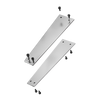
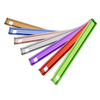
11 interchangeable CNC aluminum side panel designs are available — each changes the visual profile of the left and right frame without modifying the keyboard's internals.[7] MelGeek has also released 3D-printable model files for the internal light diffuser box, the component that shapes how the ambient bar's glow disperses.
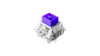
Switch options at purchase: KOM Lite and TTC Flip King. KOM Lite has a crisper sound and a more direct gaming feel; TTC Flip King sounds deeper and more muted, making it easier to live with for mixed typing and gaming. Both are 3rd-gen Hall Effect and hot-swappable through standard 5-pin/3-pin MX sockets.
MADE68 Ultra V2 vs. Ultra+: The Direct Decision
| Feature | MADE68 Ultra V2 ($219-$239) | MADE68 Ultra+ ($169) |
| Hall Effect engine | 8,000 Hz, 0.01 mm RT, Multi-MCU | 8,000 Hz, 0.01 mm RT |
| Chassis | Full CNC aluminum | Full CNC aluminum |
| Lighting | Upgraded lightbox; 360° perimeter lighting; supports the latest HIVE 2.0 lighting effects | Original lightbox; supports the latest HIVE 2.0 lighting effects |
| Mount | Silicone Dampened Gasket | Standard gasket |
| Light Side Panels | Yes — 11 designs + 3D-printable diffuser | No |
| Best for | Desk setup + competitive gaming | Competitive gaming on tighter budget |
If competitive performance is the only priority and desk aesthetics don't factor in, the Ultra+ is the more efficient purchase. The core Hall Effect functionality — the specs that affect in-game behavior — are identical between the two.[8]

Where the MADE68 Ultra V2 Falls Short
Wired only. There is no wireless option on the MADE68 Ultra V2. For most competitive FPS setups this is fine — USB-C wired is the standard for tournament play anyway. But if a wireless keyboard is a hard requirement, MelGeek's O2 ($129) exists in a different category (wireless, mechanical, 1,000 Hz), and no current MelGeek Hall Effect keyboard offers wireless.
HIVE 2.0 is available through MelGeek’s web driver and app workflow. On Mac, the keyboard works as a standard USB device, and saved onboard settings persist after configuration. The practical point is simpler: use HIVE 2.0 for key, lighting, and Hall Effect settings, then the keyboard can carry those saved settings across computers.[4]
Sold at melgeek.com (code 68V2 saves $10) and Micro Center US. Ships from US/EU/Canada — 3–6 business day US delivery. 2-year warranty from delivery.[2][9]
Frequently Asked Questions
Why does the MADE68 Ultra V2 keep appearing on best 65% keyboard lists?
It is one of the only 65% keyboards combining 8,000 Hz polling, 0.01 mm RT, Multi-MCU architecture, full CNC aluminum, and a 360° perimeter ambient light bar at $219-$239. Most boards at this price offer two or three of those — not all five.
Is the 65% layout good for FPS gaming?
Yes. A narrower board creates more table space for wide mouse movements. Arrow keys remain directly accessible. Most competitive FPS players use 60–65% layouts for this reason.
What is the difference between the MADE68 Ultra V2 and the Centauri 80?
Same Hall Effect engine (8,000 Hz, 0.01 mm RT, Multi-MCU). The Centauri 80 adds a 1.78-inch OLED touchscreen, 80% layout with direct F-row, and costs $399. The MADE68 Ultra V2 is 65% with the 360° ambient bar at $219-$239.
Does the MADE68 Ultra V2 have an F-row?
No. F1–F12 are on the Fn layer. If you need direct F-row access daily, the Centauri 80 (80%) is the MelGeek option that has it.
What colorways are available?
Night Purple, Classic Black, Frost White, and Boom Pink.
Is it hot-swappable?
Yes — standard 5-pin and 3-pin MX-compatible sockets. No soldering required.
Does the MADE68 Ultra V2 work on Mac?
Yes as a standard USB keyboard. Configuration is handled through HIVE 2.0 web/app tools, and settings stored in onboard memory persist on Mac.
References
[1] MelGeek — MADE68 Ultra V2 AI Gaming Keyboard Blog — https://www.melgeek.com/blogs/melgeek-lab/made68-ultra-v2-ai-gaming-keyboard
[2] MelGeek MADE68 Ultra V2 Product Page — https://www.melgeek.com/products/made68-ultra-v2-gaming-keyboard
[3] Toronto Keyboard Man — MADE68 Review — https://torontokeyboardman.ca/blogs/news/made-68-review
[4] MelGeek HIVE Platform — https://hive.melgeek.com
[5] PC Gamer — Best Hall Effect Keyboards 2026 — https://www.pcgamer.com/hardware/gaming-keyboards/best-hall-effect-keyboards/
[6] MelGeek Centauri 60/80 Product Page — https://www.melgeek.com/products/centauri-hall-effect-gaming-keyboard
[7] MelGeek — Hall Effect Keyboard Customization Guide — https://www.melgeek.com/blogs/melgeek-lab/custom-hall-effect-keyboard-guide
[8] MelGeek — MADE68 Ultra+ vs MADE68 Ultra V2 — https://www.melgeek.com/blogs/melgeek-lab/made68-ultra-plus-vs-ultra-v2
[9] MelGeek Warranty Policy — https://www.melgeek.com/pages/warranty-policy