







Hall Effect keyboards have been around in enthusiast circles for a while, but 2025–2026 is the year they broke into the mainstream gaming market. The result: almost every brand now lists specs like '8,000 Hz polling' and 'Rapid Trigger,' and almost none of them explain clearly what those numbers mean in practice. This guide is for anyone trying to figure out which specs are worth paying for, which ones are mostly noise, and what a real-world purchasing decision should actually look like.
How Hall Effect Switches Work
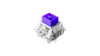
A Hall Effect switch has no physical contact points. A small magnet sits inside the switch stem, and as you press the key down, that magnet moves past a Hall Effect sensor embedded in the PCB. The sensor continuously measures the changing magnetic field and converts it into a position reading — updated thousands of times per second, accurate to fractions of a millimeter.[1]
This is what separates Hall Effect from mechanical at a hardware level: a mechanical switch closes an electrical circuit at a fixed point. Hall Effect gives the keyboard continuous positional data on every key, at all times. That's what makes Rapid Trigger, per-key adjustable actuation, and Dynamic Keystroke possible — none of these features can exist on a mechanical switch without additional hardware.
Polling Rate: When 8,000 Hz Actually Makes a Difference
Polling rate is how often the keyboard reports its state to your PC. 1,000 Hz means once per millisecond. 8,000 Hz means once every 0.125 ms.
| Polling Rate | Report Interval | Where It Matters |
| 1,000 Hz | 1 ms | Standard gaming — more than sufficient for most users |
| 4,000 Hz | 0.25 ms | Pairs well with RT at 0.1–0.3 mm sensitivity |
| 8,000 Hz | 0.125 ms | Most impactful at RT settings of 0.01–0.05 mm — competitive FPS |
The honest take: upgrading from a standard 1,000 Hz keyboard to any Hall Effect board with Rapid Trigger will feel noticeably more responsive — but RT is responsible for almost all of that perception shift, not polling rate alone.[2] Where 8,000 Hz matters on its own: when you're using RT at very tight sensitivities (0.01–0.05 mm), the keyboard is registering key releases and re-presses within windows of a few tenths of a millimeter. At 8,000 Hz, those windows are reported with significantly less time uncertainty. Both the MADE68 Ultra V2 and the Centauri 80 run at 8,000 Hz via USB.[5][6]

Rapid Trigger: The Feature That Changed Competitive FPS
Every conventional keyboard key has a fixed actuation point (where it registers as pressed) and a fixed reset point (how far it must travel back up before it can register again). For a typical linear switch, there's a 0.3–0.5 mm gap between those two points — hysteresis. That gap limits how fast you can chain rapid directional inputs.
Rapid Trigger replaces the fixed reset point with a dynamic one. The moment the key starts moving upward, the keyboard starts tracking. Once it has moved up by your configured sensitivity — as small as 0.01 mm on the MADE68 Ultra V2 and Centauri 80 — the keyboard registers a release.[4][5] No waiting for a fixed position. For counter-strafing in CS2 or Valorant, where the precision and speed of A/D direction changes directly affects how responsive your movement model feels, this is the spec that competitive players test first.[3]
| RT Sensitivity | Practical Meaning | Best For |
| 0.5–1.0 mm | Wider margin — forgiving, less fatiguing | Casual gaming, productivity |
| 0.1–0.3 mm | Competitive range for most FPS players | Valorant, CS2, Apex — standard competitive |
| 0.01–0.05 mm | Maximum responsiveness — requires deliberate keystrokes | High-level competitive FPS |
Per-Key Actuation: A Feature Worth Actually Configuring
Hall Effect keyboards let you set a different actuation point for every single key. On the MADE68 Ultra V2, that range is 0.1–3.4 mm, configured per key in HIVE 2.0.[5][7][8] A practical setup: WASD at 0.3 mm for immediate response to light touches, spacebar at 1.5 mm to avoid accidental presses during jump sequences, ability keys at 1.0 mm for deliberate triggers. It takes 10–15 minutes to configure once and rarely needs revisiting — but competitive players who've done it consistently say it makes a meaningful difference in how precise multi-key inputs feel during fast gameplay.
Multi-MCU Architecture: What It Means Under Load
At 8,000 Hz, the keyboard's processor has to read all key states and report to the PC 8,000 times per second. A single microcontroller handling all of that can fall behind under heavy simultaneous input — WASD plus three ability keys plus a macro press during a teamfight.[5]
Multi-MCU architecture splits the work by zone. On the MADE68 Ultra V2, a main controller oversees five sub-controllers, each responsible for a specific section of the keyboard. Under high simultaneous input load, zones process independently without queuing behind each other. Some keyboards advertise 8,000 Hz polling but process all keys through a single controller — the polling rate number is accurate for isolated key presses but may not hold under real gaming conditions.
SOCD and Dynamic Keystroke: Two Distinct Features
SOCD handles one specific scenario: A + D held simultaneously. On a standard keyboard, opposing inputs cancel. Snap Tap registers only the most recently pressed key — so pressing D while holding A immediately gives you D input.[5][6] Combined with tight RT, direction changes happen within the physical movement window of your finger rather than being limited by switch reset timing.
Dynamic Keystroke (DKS) is different: up to four sequential actions assigned to a single key at different press depths. At 0.5 mm the key sends action 1; at 1.5 mm it sends action 2; at 2.5 mm a third. Available on MADE68 Ultra V2 and Centauri 80 via HIVE 2.0.[4][5][8] Useful in games where the same key triggers walk vs. run vs. sprint depending on press intensity.

Mount Type: Comfort, Not Performance
Gasket mounting sits the PCB on a flexible cushion rather than hard-mounting it to the case. The result is a slight bounce on bottom-out that reduces impact on your fingertips — relevant for long sessions, not for polling rate or RT precision.[1] The MADE68 Ultra V2 uses a Silicone Dampened Gasket Mount; the Centauri 80 uses a Tinned Spring Gasket. Both are noticeably more comfortable than plate-mounted designs for extended use. If you're buying specifically for a competitive gaming session that lasts two hours, mount type is secondary. If you use the same keyboard for gaming and four hours of typing daily, the difference in how your hands feel is real.
What to Expect at Each Price Point
| Budget | Typical RT Precision | Polling Rate | Architecture | What You Get |
| Under $150 | 0.1–0.5 mm | 1,000–4,000 Hz | Single MCU typical | Hall Effect basics — RT works, limited configuration depth |
| $150–$250 | 0.01 mm | 8,000 Hz | Multi-MCU on top models | Full competitive spec stack — MADE68 Ultra V2 ($219) is here |
| $250–$400 | 0.01 mm | 8,000 Hz | Multi-MCU | Adds OLED touchscreen, premium acoustics — Centauri 80 ($399) |
The biggest performance jump is getting any Hall Effect board with RT. Going from $219 (MADE68 Ultra V2) to $399 (Centauri 80) adds the OLED touchscreen for on-keyboard configuration and an 80% layout with direct F-row — meaningful if you want those things, but not required for the performance stack.[5][6]
Frequently Asked Questions
What is a Hall Effect keyboard?
A Hall Effect keyboard uses a magnetic sensor under each key to continuously read key position, rather than detecting a physical contact. This enables Rapid Trigger, adjustable actuation, and other features that mechanical switches can't support.
What polling rate do I need for competitive FPS?
8,000 Hz is the current standard for competitive Valorant, CS2, and Apex. For most non-competitive gaming, 1,000 Hz is sufficient — the bigger gain comes from switching to Hall Effect with Rapid Trigger.
What is Rapid Trigger?
Rapid Trigger registers a key release as soon as the key moves upward by a configured distance (as small as 0.01 mm), instead of waiting for the key to return to a fixed mechanical reset point. This enables faster chained inputs and more responsive counter-strafing.
What RT sensitivity should I start with?
0.1–0.3 mm is the practical competitive range for most FPS players. 0.01 mm is the minimum on the MADE68 Ultra V2 and Centauri 80 — effective for maximally responsive counter-strafing but requires deliberate keystrokes to avoid accidental inputs.
What is Snap Tap?
Snap Tap makes the keyboard register only the most recently pressed key when A and D are held simultaneously, eliminating the movement cancellation that normally occurs with opposing inputs in FPS games.
Does gasket mount improve gaming performance?
No — it improves typing comfort and reduces keystroke impact during long sessions. It does not change polling rate, RT precision, or any competitive gaming spec.
What is Multi-MCU on a keyboard?
Multi-MCU splits key processing across multiple controllers by keyboard zone. On the MADE68 Ultra V2, one main controller coordinates five zone sub-controllers, so simultaneous multi-key inputs don't queue behind each other during intense gameplay.
References
[1] MelGeek — Magnetic vs. Mechanical Keyboards: What's Actually Different in 2026 — https://www.melgeek.com/blogs/melgeek-lab/magnetic-vs-mechanical-keyboards-whats-actually-different-in-2026
[2] MelGeek — Wired vs. Wireless Gaming Keyboard — https://www.melgeek.com/blogs/melgeek-lab/wired-vs-wireless-gaming-keyboard
[3] PC Gamer — Best Hall Effect Keyboards 2026 — https://www.pcgamer.com/hardware/gaming-keyboards/best-hall-effect-keyboards/
[4] MelGeek — MADE68 Ultra V2 AI Gaming Keyboard — https://www.melgeek.com/blogs/melgeek-lab/made68-ultra-v2-ai-gaming-keyboard
[5] MelGeek MADE68 Ultra V2 Product Page — https://www.melgeek.com/products/made68-ultra-v2-gaming-keyboard
[6] MelGeek Centauri 60/80 Product Page — https://www.melgeek.com/products/centauri-hall-effect-gaming-keyboard
[7] MelGeek — Hall Effect Keyboard Customization Guide — https://www.melgeek.com/blogs/melgeek-lab/custom-hall-effect-keyboard-guide
[8] MelGeek HIVE Platform — https://hive.melgeek.com